Showing posts with label JEDCO. Show all posts

Monday, March 23, 2020

Cherokee County property tax appraisal – How taxpayers pay for nepotism


State Comptroller- Those with property in Cherokee County owe the State in school taxes:

Jacksonville ISD- $1 million

Rusk ISD- $700,000

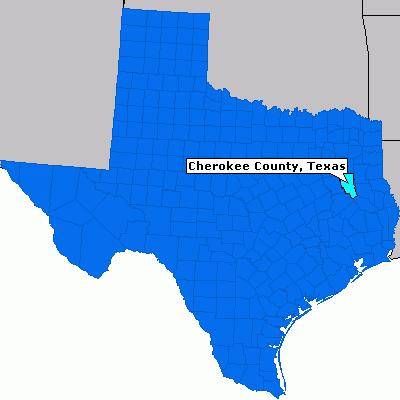
Cherokee County, TX:
For decades land owned by the Good Ol’ Boys and Biddys has been appraised at a substantially lower (almost zero) tax rate compared to property owned by those not in the clique. A quick online review of elected officials’ appraised property tax values shows the glaring discrepancies. Cherokee County appraises commercial property in Jacksonville at 15% below actual market value, and 35% below realistic estimates in Rusk according to a recent State Comptroller’s property tax audit. (Source: Daily Progress)

Local attorneys, JEDCO and Chamber of Commerce members own the most valuable commercial and rental properties in Cherokee County and have favored status with the Cherokee County Appraisal District. They own the Low Income Housing, the halfway houses, and the old folks' homes, i.e. privately owned subsidized Section 8. They get first shot at federal housing authority grants.

Even though they own the majority of taxable properties within Cherokee County, they do not share the tax burden.

On the other hand, those who are not in the good graces of CCAD are hit arbitrarily with high taxes and lawsuits, forcing many to leave. To mitigate the loss, out of region companies are enticed to set up shop and pay into the County coffers or they too risk being sued out of existence. By hook or by crook, Cherokee County puts nepotism over the needs of its residents, regardless of the dwindling tax base loss to local school districts. Property owners living outside the county coterie can expect their Balance Due Notices in the mail first.

Why should those who run the county into the ground pay property tax?

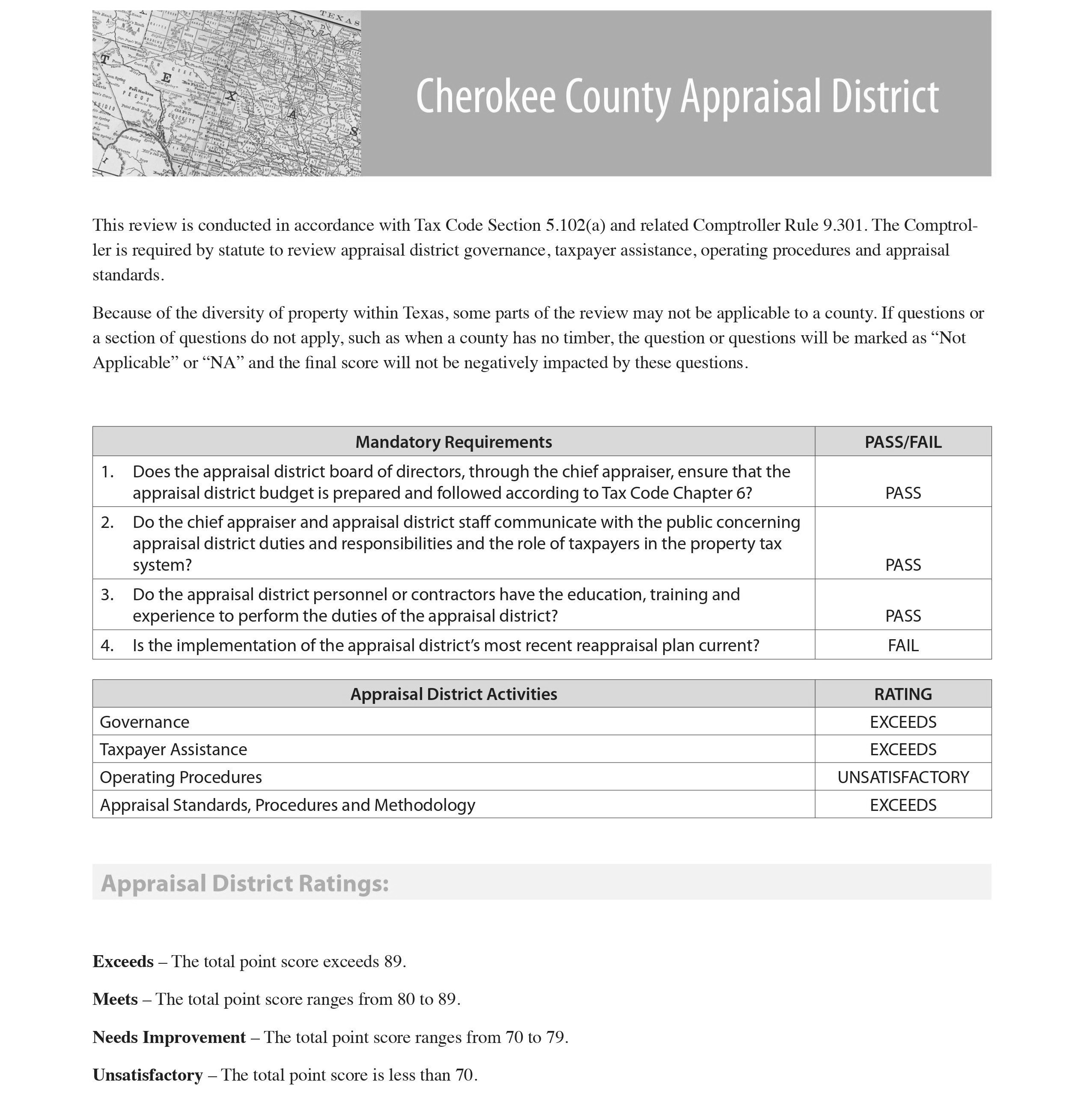
In 2012 the State Comptroller's Office found the Cherokee County Appraisal District "UNSATISFACTORY" in its operational procedures and ability to implement a reappraisal plan. (Source: State Comptroller) School district tax values would continue to be reported too low under the State's enhanced Methods and Assistance Program auditing every 2 years.


School Board elections have consequences.

In 2015, Cherokee County had failed the State's audit of Non-Farm properties along Lake Striker in the New Summerfield School District. Residential sales were "not previously available" and those they recorded were as far as 25% below actual Market Value. Kinfolks' homesteads on Lake Striker had their unpaid tax liability limited at a 10% increase, while the rest of the county taxpayers made up the difference. (Source: Cherokee CAD) This shell game keeps the public from petitioning for a property tax rollback election and School Board members will never vote for a tax rate rollback. (Source: Texas State Comptroller)


Do you know who is on your Agricultural Appraisal Advisory Board? 

In a 2015 property tax exemption workshop held in Jacksonville, TX for Cherokee County landowners, Chief Appraiser Lee Flowers blamed farmers' excessive agricultural and timber exemptions for the low residential property values. Meanwhile lake front property sales taxes are skirted or not recorded at all.
Cherokee County landowners fight tax break changes, March 29, 2015
Cherokee County Chief Appraiser Lee Flowers said around two-thirds of 2,900 property exemptions could be in jeopardy of failing to meet state requirements.
The district would require landowners with agriculture exemptions to provide proof of productivity and meet state production requirements. So landowners who produce hay must provide proof they are producing hay at amounts and quality levels consistent with state and regional numbers. Cow-calf operations would be required to meet per-acre head counts consistent with production requirements, he said.
A landowner claiming his property is an orchard, but only has four fruit trees on 10 acres, won't make the cut anymore, he said.
"We're aiming to stop abuses of what's required by state law," Flowers said. "So is it a qualified production operation or that ‘I just want lower taxes?'"
The same goes for land with timber exemptions. (Source: Tyler Paper, Cherokee County landowners fight tax break changes, March 29, 2015)
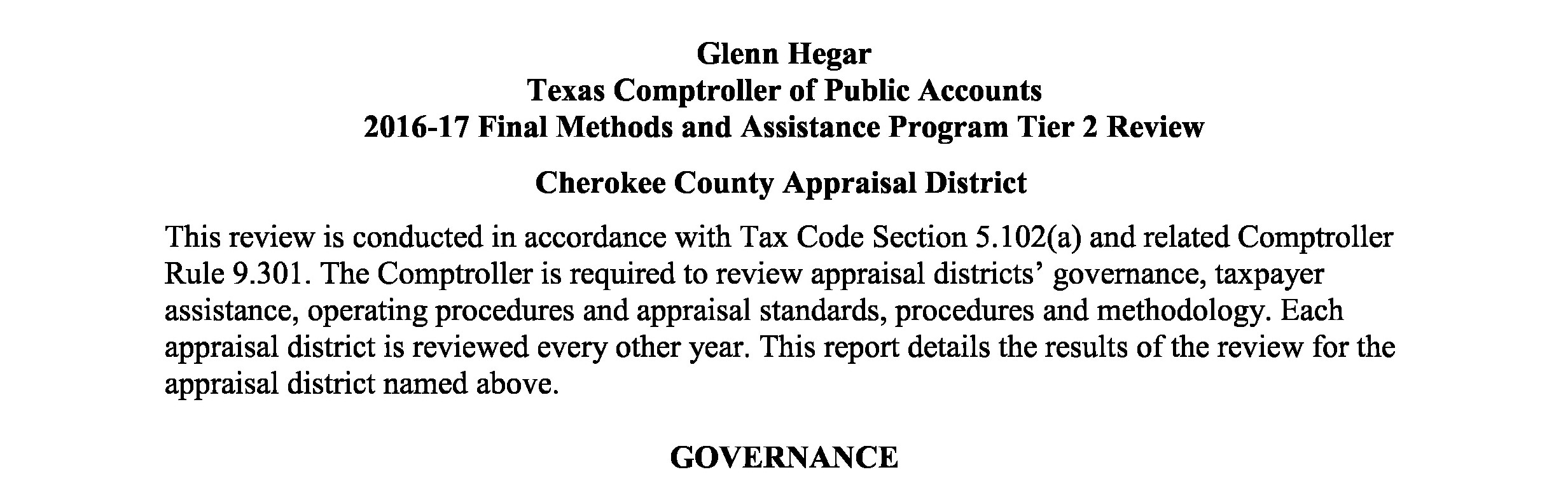
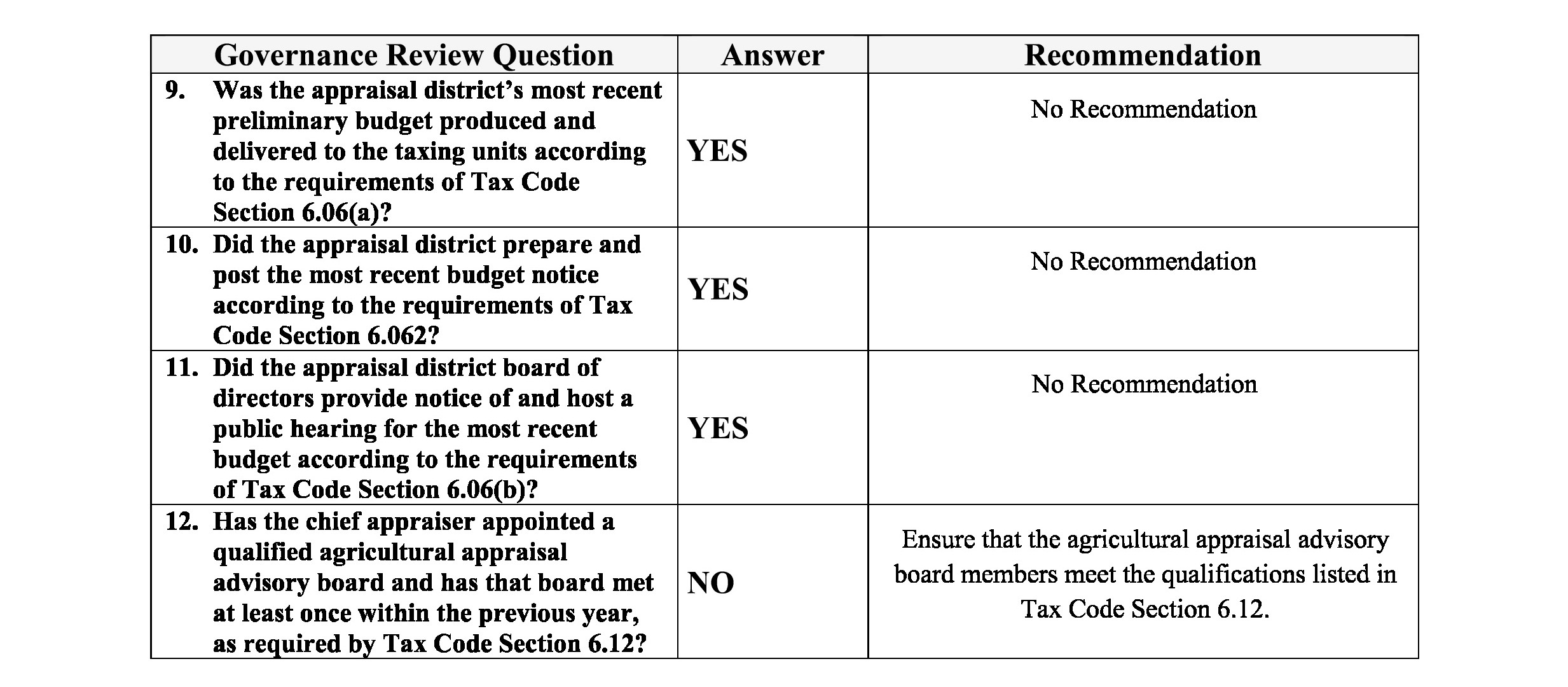
Two years later, the State Comptroller found in the 2016-2017 MAPS Report that Cherokee County's  Chief Appraiser had not appointed a qualified agricultural appraisal advisory board to meet once a year as required by Tax Code 6.21 (Source: State Comptroller)
 TAX CODE TITLE 1
Sec. 6.12. AGRICULTURAL APPRAISAL ADVISORY BOARD. (a) The chief appraiser of each appraisal district shall appoint, with the advice and consent of the board of directors, an agricultural advisory board composed of three or more members as determined by the board.
(b) The agricultural advisory board members must be landowners of the district whose land qualifies for appraisal under Subchapter C, D, E, or H, Chapter 23, and who have been residents of the district for at least five years.
(c) Members of the board serve for staggered terms of two years. In making the initial appointments of members of the agricultural advisory board the chief appraiser shall appoint for a term of one year one-half of the members, or if the number of members is an odd number, one fewer than a majority of the membership.
(d) The board shall meet at the call of the chief appraiser at least once a year.
(e) An employee or officer of an appraisal district may not be appointed and may not serve as a member of the agricultural advisory board.
(f) A member of the agricultural advisory board is not entitled to compensation.
(g) The board shall advise the chief appraiser on the valuation and use of land that may be designated for agricultural use or that may be open space agricultural or timber land within the district. (Source: Texas Property Tax Code)
The most recent 2018 audit "FAILED" the County's record keeping and property valuation procedures. (Source: State Comptroller)


Nepotism is a recipe for disaster.

The trend of not accurately recording real estate sales and shorting the State in property taxes continues today. 

As a result, the State Comptroller’s Office audit will penalize taxpayers $1 million in the Jacksonville School District and $700,000 in the Rusk School District.

The decision is on appeal. Taxpayers can expect another School Bond election and sales tax hike on the horizon. The school districts will ask for new facility funds that will actually go to pay off the tax deficit and funnel money back to Good Ol' Boy construction projects. Tax revenue from new construction will be excluded to solicit businesses while farms, ranches, and dairies will be hit hardest. As the State Comptroller found, Cherokee County "record keeping" does not pass the smell test.
Cherokee County Appraisal District fails state property study.
Feb 13, 2020
RUSK – Annual property study results recently released by the State Comptroller’s Office do not bode well for some Cherokee County taxpayers, said Cherokee County Chief Appraiser Lee Flowers.
According to information issued by the state Comptroller’s Property Tax Assistance Division, Jacksonville and Rusk schools could be penalized severely in state funding if a pending appeal by the appraisal district is not successful, Flowers said in a Feb. 12 release issued by his office.
“We first received notification on Jan. 31,” with amended updates arriving at his office later because “they've had to reissue numbers a couple of times,” Flowers said.
The state's study indicates the local appraisal district is below market value on both residential and commercial real estate valuations in the two school districts. The effect of an unsuccessful appeal could penalize JISD a million dollars and RISD $700,000 in overall state funding, according to the CCAD release.
Flowers said he doesn't agree with the state's overall assessment of commercial values, based on the market information available to his office.
“They (state findings) indicate we are 15 percent low on commercial real estate in JISD and 35 percent low on RISD commercial real estate. These types of property in our county are difficult for anyone to appraise,” he explained. “However, if the state has reliable data not previously available to us, we will analyze their information and move forward accordingly.”
Data from property value studies – which “looks at our values and our at-market values” – and something called a “MAP audit” (methods and assistance program audit) alternate each year, he said.
“The most recent MAP audit was in 2018, while the value study was in 2019,” he said, explaining that a grace period is what gaps the two.
“It is apparent that these schools might have received a grace period if not for a failure in the appraisal district’s most recent state procedures audit,” the CCAD release stated. “This grace period would have held the schools harmless in state funding for one year.”
For a school to qualify for the grace period, the state requires that the local appraisal district must score a “pass” on four key questions.
In 2018, the appraisal district missed one of those key questions, the release stated.
“That question contained 15 subparts. Of those subparts, Cherokee CAD passed all but one. In order for that key question to be considered a 'pass,' all 15 subparts must have been a 'yes.' Overall, the appraisal district successfully passed 77 out of 80 questions in the audit,” it added.
“The subpart preventing grace relates to the valuation of low-income housing. I made a decision to focus our resources on other critical matters relating to 2019 values, and take up the question of low-income housing data in 2020,” Flowers said, noting that the low-income housing question was not in previous audits.
He and his staff had from December to April to correct the deficiency.
“We would have appreciated either an earlier notice of the question’s inclusion or more time to assemble the data in order to properly implement the correction,” he said.
Currently, Flowers is appealing the value study, which has a March 23 deadline.
“Originally, it was March 11. The extra time can't hurt us, but that also delays any kind of resolution. If we think we have enough to file and feel comfortable in doing so, we'll file sooner,” rather than wait, he said.
Meanwhile, his office is focused on looking at all the properties considered by the state in their findings, and “we've submitted a request to see their work files,” Flowers said.
If the appeal is successful, the potential for loss to the schools could either be eliminated or substantially reduced, he said. (Source: Daily Progress)

Tuesday, December 20, 2011

Parasites make for good bedfellows; Low scores for free college

It must be Christmas time in Cherokee County. Cherokee County Bar Association members pretend to run as opposing candidates to hedge votes away from viable office seekers potentially challenging the status quo during the upcoming primaries. Local newspapers repeat the facade to keep the cronyism alive and well. According to the liars, Cherokee County voters are supposed to believe that the Assistant District and Assistant County attorneys are actually vying for their bosses' positions by running against the incumbent who employs them. (Source: Tyler Paper, Incumbents Face Opposition In Coming Cherokee County Elections, Dec. 18, 2011) That would be like Joe Biden switching to the Republican Party to challenge President Obama in the general election. So far, Cherokee County incumbents are running unchallenged again.

Meanwhile like clockwork, local attorneys make up reasons to bill the taxpayers by “settling” legal issues made up to exploit legitimate public concerns. Their job is deflecting attention away from the generational corruption and bilking the public coffers.

First, bogus legal crisis are created within the local city councils for embedded attorneys to charge hourly rates; it is the taxpayer who foots the bills. These lawyers have a blank check to solve these "issues" of public concern, that are issues that they themselves create. ‘Opposing counsel’ play both sides of made-up legal arguments that have no basis in fact, instead of addressing WHERE THE MONEY IS GOING. For decades, they stir up scenario another scenario between each other to pay their car notes, mortgages and children's college tuition. With councilmen on board for the perpetual ruse, they drag out a hodgepodge of legal filings until their agreed amount of money is allocated. All parties involved time the intended resolution of their fabricated "issue" towards the end of the fiscal year, when attorney fees are buried in city and county budget reports.

Secondly, local governments employ unaccountable members of the Cherokee County Bar Association to conceal the nepotism. Their job is to steer the community’s attention away what is really going on, by creating a rabbit trail of drawn out legal minutiae or fictitious campaigns. The local newspapers are recruited to dumb down the process and put a final spin on the cover up. They never answer the basic questions such as "Who got the money and how much do these homegrown attorneys cost the taxpayer?" Or "Why is your so-called political opponent paying for your campaign?" It is all a money game to them.

The winners are the usual small town lawyers whose entire income comes from pubic sources, and therefore without oversight. After the smoke screen settles and the law is correctly interpreted, those on opposing sides can be found “on the same page.” The same page they were on from the beginning, between the sheets and behind closed doors.


What's the deal with these guys working hand-in-hand to earn a living, even as opposing parties in lawsuits and criminal cases? Their wives work at the same shops on the Rusk, TX square and downtown Jacksonville. They are officers of the same companies for tax abatement purposes. They carpool to church together and are on each other’s Christmas card list. For some, that relationship goes beyond the amiable and into the bedroom. Exchanging pictures of each other's wives in uncompromising positions keeps them on the same page and willing accomplices of the money grab. If a member of the Good Time Association steps out of line, they can expect to be sexually blackmailed with humiliating love letters, Glamour Shots and hotel receipts to their significant other or minister of their choice.

Meanwhile they also screw the county out of tens of thousands of dollars of public funds each year.

There is little fiscal oversight in the dark crevices of Cherokee County, Texas- just an engrained buddy system designed to sponge off the economic development of the county. A recent November 5, 2011 Daily Progress article “JEDCO’s accountability for nearly $1M in funds question” pretends to tackle the need for oversight.

JACKSONVILLE— Jacksonville city officials have provided little oversight of the Jacksonville Economic Development Corporation's handling of roughly $1 million annually in taxpayer money.

JEDCO's failure to get city council approval before awarding economic development grants to local businesses appears to violate state law.
The article goes on to further state,
The seven-member board is not elected and is accountable to the city council, according to JEDCO's founding documents.

The council is responsible for appointing members to the board and has the authority to remove members as well as reorganize or dissolve the corporation.

The Jacksonville Daily Progress asked five current and former city officials why the city has not fulfilled its obligation to ensure JEDCO follows state law, but none would answer on the record. (Source: Daily Progress, Nov. 5, 2011)
It is a moot point that a handful of people call the shots of where to spend $1 million of taxpayer dollars. JEDCO “volunteers” are appointed by the Jacksonville city council who (taxpayers are to believe) ironically were demanding oversight of their appointees (i.e. lovers and kinfolk). (Source: Jacksonville Progress, JEDCO, city struggle lasted more than a year, Nov. 19, 2011)

Yet the city council and local newspapers never ask to see the attorney bills nor answer the question “WHO GOT THE MONEY???”

Furthermore, if it is within the city charter to manage a quasi-government organization such as an economic development corporation, then why do attorneys need to rehash and re-bill for the same old ground for over a year? They don't need to because the "city struggle" between JEDCO and city attorneys is only a means for these entities to milk the taxpayer. The same people have their fingers in the local school systems as well.

Another of Cherokee County’s institutions of higher learning, whose budget consists entirely of government Student Loan grants and "gifts," cannot pass the financial responsibility test of Federal Student Aid programs because they won't keep the money in reserve. (Source: Daily Progress, Dec. 9, 2011) KETK reports that Lon Morris Jr. College, located in Jacksonville, TX , delayed paying its staff for the umpteenth time this year. (Source: KETK, Lon Morris College delays paychecks again, Dec. 5, 2011)

Local newspapers con their readers by suggesting the current economy has something to do with teachers not being paid at the college. (Source: Tyler Paper, Some Lon Morris employees paid late, Dec. 6, 2011) Lon Morris continues to have its finances out of compliance, while at the same time being propped up by the local media as a viable Christian alternative to neighboring Tyler Jr. College. Since 2010, Lon Morris faculty continues to have their paychecks in limbo (Source: Tyler Paper, Dec. 6, 2011) while the school's enrollment has doubled. The school continues to run on a deficit on the books and spends the Financial Student Aid deposits into the red. Where is the money going?

Earlier this year, KETK went to the Lon Morris College grounds in Jacksonville to interview employees and faced Cherokee County's typical cult-like silence.
We found that employees and students alike are concerned about the finances at Lon Morris. When we went to the college, we were quickly informed by officials that employees were told not to say a word.

One student, Theodore Lloyd, says, "I need to know if this school is going bankrupt because I need to stop putting my money into it."

Lon Morris officials are not giving students any answers. (Source: KETK, Lon Morris College employees not getting paychecks, April 5, 2011)
Why not try asking the Lon Morris Board of Trustees to do an internal and public audit? Surely members of Cherokee County's CPA association would like a shot at billing the taxpayer for services rendered. The fact is the college's "financial obstacles," as it is spun, are not due to any bona fide economic challenge. According to the college's webpage, 88% of Lon Morris students are on scholarships and 95% are on Federal Financial Aid.

In 2010, Lon Morris awarded over $1 million in financial aid to a student body of less than 1000. (Source: Wikipedia) Despite this, the college will have to submit a letter of credit within 30 days to the DOE that it will keep at least 10% of the Financial Student Aid money in reserve and submit to administrative oversight. The Department of Education scores Lon Morris as "not financially responsible." (Source: Tyler Paper, Dec. 13, 2011)

US Department of Education crime data also shows the 2 year college to have a low student retention and graduation rate, as well as a "relatively unsafe place" to go to school. (Source: American School Search) Quite the opposite from the spin promoted by local newspapers; these Lon Morris crime stats were never mentioned: between 2007 and 2009 there were 13 on-campus burglaries, 4 robberies, 2 aggravated assaults and 4 stolen vehicles. (Source: KLTV, East Texas college struggles with gang problem, Sep. 15, 2010) 11 students were expelled from the college last year after a gang related shooting. (Source: Daily Progress, LMC shooting still being investigated, Sep. 14, 2010)


Lon Morris student housing courtesy KETK.

In May 2011, the US Department of Education also found that Lon Morris was in violation of Federal Aid distribution requirements by holding students' financial aid checks over 2 weeks after receiving them from the government. No doubt deposited in the First State Bank to draw a little interest off of. (Source: Daily Progress, LMC violates federal aid regulation, May 18, 2011) In Cherokee County there is no accountability for those holding the purse strings.

It doesn't matter if the money comes from inflated property taxes, unreported Sales Tax revenue, stealing it out of people's mail, bogus farm claims or Federal tuition assistance programs, it won't appear on the county books because it will be in these people's personal bank accounts.

To whom is the money going? In Cherokee County it goes to the families of these parasites whose spouses work together and share the same gene pool. They are business partners through and through, easily spotted divvying up gifts of insurance payouts and pretending to not only be opposing counsel, but political rivals.

As a footnote, Lon Morris College has been placed on a 12-month public sanction by the Southern Association of Colleges and Schools Commission on Colleges (SACS COC) for "significant financial and accreditation noncompliance." (Source: KETK, Dec. 22, 2011)